
Research
Terahertz Astrophotonics
Terahertz (THz) spectroscopy holds significant importance owing to the abundance of molecular and atomic fingerprint lines within this frequency range. In astronomy, THz spectroscopy provides a powerful probe of rotational and vibrational transitions of molecules, offering insights into star and planet formation as well as the physical and chemical processes in galactic and interstellar environments.
Conventional THz spectrometers typically rely on multiple free-space optical elements or moving parts, which makes them bulky and challenge to integrate into compact systems. Metasurfaces – planar optical components composed of subwavelength nanostructures, have recently emerged as a powerful new approach for controlling the polarization, phase, and amplitude of light with unprecedented flexibility. These advances open the door to the design of highly compact and versatile spectroscopic instruments.
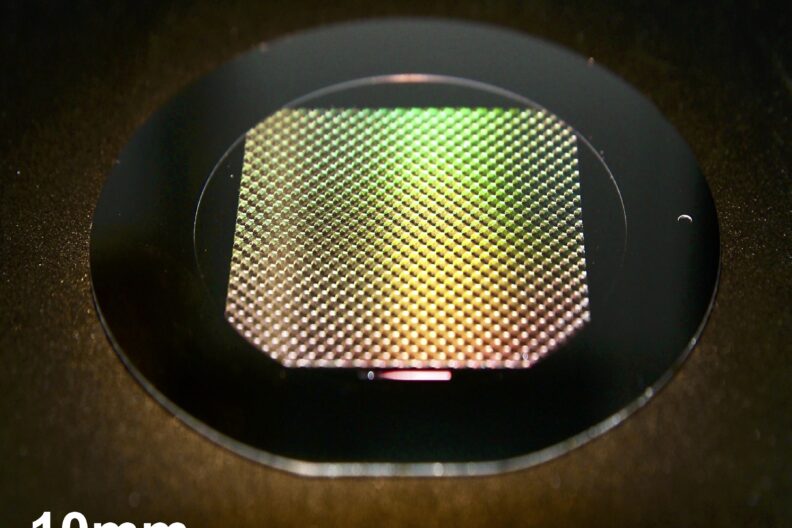
Ren et al. (2024) demonstrated multi-wavelength phase gratings composed of segmented metasurface elements incorporating multiple nanostructures. The resulting transmissive grating produced highly uniform diffraction beams while maintaining identical diffraction angles at two distinct frequencies, enabling efficient multi-frequency wavefront control.
Luo et al. (2026) demonstrated a compact terahertz spectrometer that integrates a phase grating and two transmissive metasurfaces on a single platform. The system achieved a frequency resolution better than 21 GHz while occupying less than 1% of the footprint of a conventional terahertz time-domain spectroscopy (THz-TDS) system, providing a highly compact solution for high-resolution terahertz spectral analysis.
Terahertz Heterodyne Spectrometer
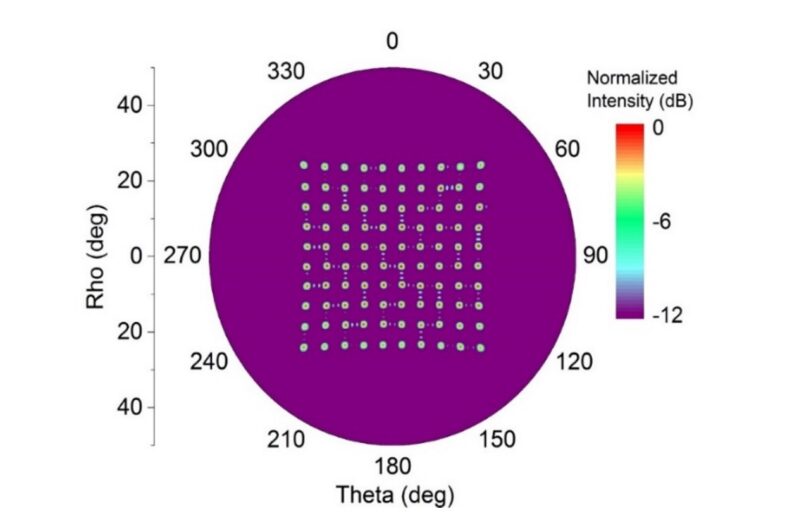
A heterodyne receiver, consisting of a mixer and a local oscillator, is of crucial importance for astronomical observation and atmospheric remote sensing in the submillimeter wavelength range, due to its high spectral resolution (ν/Δν>106) and quantum limited sensitivity. Nowadays, multi-beam heterodyne receivers play a vital role in single dish astronomical observations, due to their improved mapping speed with an enhanced number of pixels.
Ren et al. (2021) adapted the Gerchberg–Saxton (GS) algorithm through the Mixed-Region-Amplitude-Freedom (MRAF) approach to design terahertz two-dimensional phase gratings capable of generating arbitrary diffraction patterns. This work demonstrated flexible wavefront engineering at terahertz frequencies and paved the way for the development of large-format multi-beam heterodyne receiver arrays for terahertz astronomy and imaging applications.
Ren et al. (2019), Kloosterman et al. (2013), and Ren et al. (2012, 2011, 2011, 2010) developed submillimetre and mid-infrared superconducting heterodyne receiver based on a quantum cascade laser (QCL) and a superconducting hot-electron bolometer (HEB) mixer. This work resulted in the first fully stabilised HEB-QCL receiver, providing a powerful laboratory tool for high-resolution terahertz spectroscopy and laying a technological milestone for NASA’s GUSTO balloon mission.